
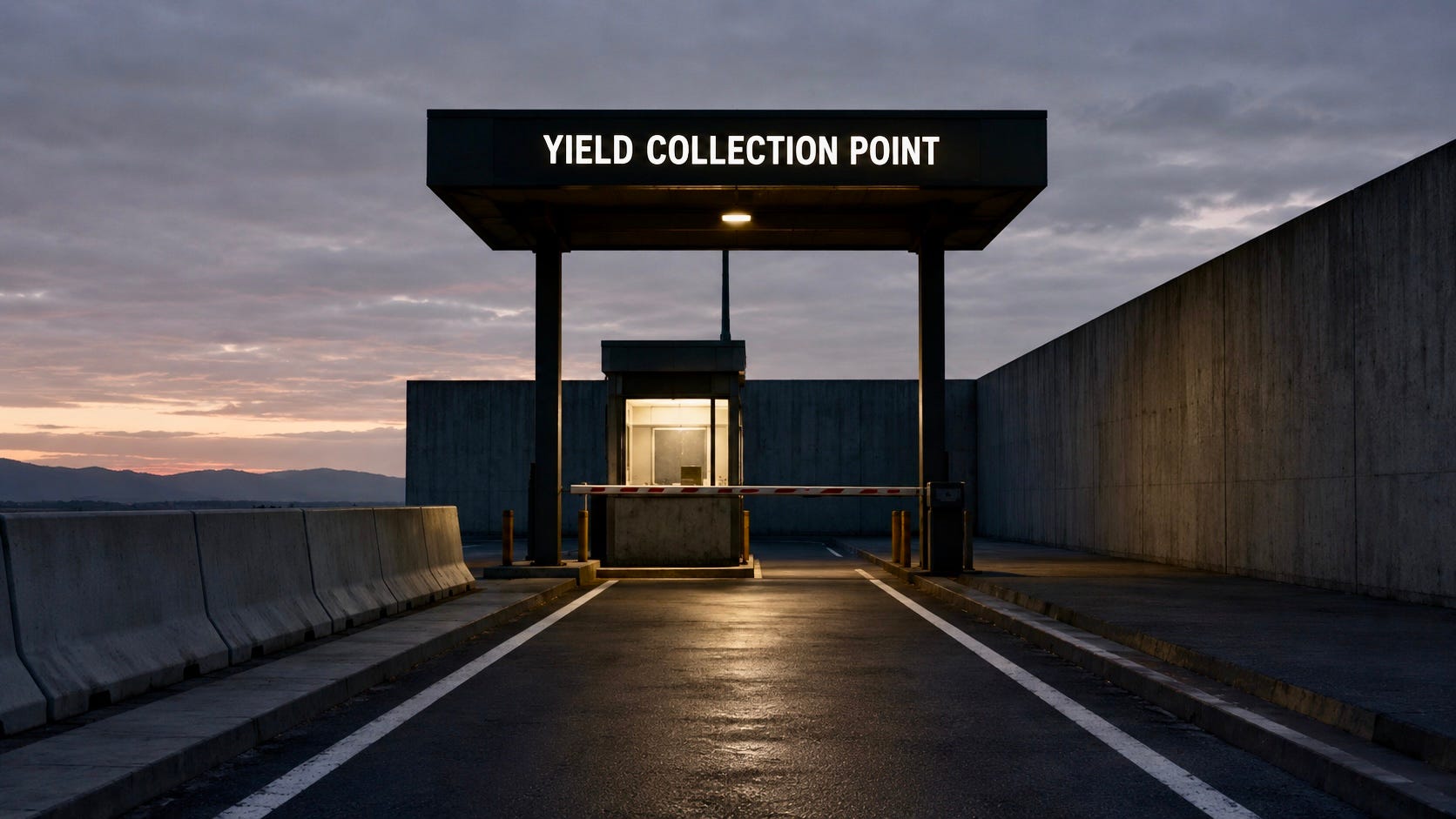
They Bought the Traffic and Kept the Toll Booth
WLFI holders funded the incentives that made USD1 look inevitable. Trump-family entities collect the yield from the traffic.

All research and reporting by WLFireside · Langdon Cage · May 25, 2026
WLFI holders thought they were buying a piece of the machine.
They were buying the fuel.
World Liberty Financial spent roughly $115 million in WLFI-token incentives to push USD1 up the stablecoin rankings — paying exchanges, traders, lenders, and liquidity farmers to make the Trump family’s stablecoin look inevitable. The holders who funded that climb were sitting in a token down more than 80 percent, restricted from freely selling, and excluded from the Treasury yield the stablecoin produces.
They bought the governance token. The governance token bought the adoption. The adoption produces the float. The float pays the insiders.
The trick was making retail think WLFI was the prize. WLFI was the payment method.
The Receipt
Analysis from an on-chain analyst, Yu Jin, was reported this week. Over four months, WLFI deployed more than $115 million — denominated in WLFI governance tokens — across a coordinated set of incentive programs: interest rate subsidies on Binance and Bybit, activity bonuses on Aster, lending rate subsidies through Dolomite. The result was a stablecoin that grew from $3.1 billion to $4.76 billion in circulating supply, rose from seventh to fourth among dollar stablecoins, and generated average daily trading volume of $2 billion — up tenfold from the $200 million it was seeing before the subsidies started.
Those numbers are real. The story attached to them is not.
Organic adoption is when people choose your product because it serves them better than the alternatives. This is not that. This is the oldest play in financial history: pay for the appearance of demand until the demand becomes real enough that you stop needing to pay for it. WLFI is still paying. The subsidy programs are still running.
What they bought with that $115 million is a stablecoin reserve base large enough to generate approximately $159 million per year in Treasury yield. Seventy-five percent of that flows automatically to DT Marks DeFi LLC — the Trump family’s holding entity — for as long as USD1 stays in circulation.
The people who paid for the adoption got a falling governance token. The people who collected from the adoption got Treasury yield.
The Loop Is Almost Insulting
Print the governance token. Restrict the exits. Use the token as coupons. Buy stablecoin traffic. Report the traffic as adoption. Collect Treasury yield from the reserves the traffic created. Tell the people holding the coupons that ecosystem growth is coming.
That is the mechanism. It required WLFI to control the paper, the vote, the subsidy, and the income stream simultaneously. In this case, they do. What retail was actually being asked to do:
convert dollars into USD1 →
park USD1 to earn WLFI →
use WLFI to purchase more USD1 →
park more USD1 →
earn more WLFI →
Loop ↻
Exiting is never a clean option — selling WLFI means hitting a thin market on a restricted token, redeeming USD1 means walking away from yield that keeps looking marginally better than leaving. The machine doesn’t need to trap anyone. It just needs the exit to always feel slightly worse than staying.
This is not an incentive program. It’s a roach motel denominated in dollars.
And the detail that makes it dirtier than a standard yield trap: the underlying dollar never moves. When retail parks USD1 and earns WLFI, the reserve sits in U.S. Treasuries at Cantor Fitzgerald, generating yield that flows to DT Marks DeFi. Retail earns the coupon. The house earns the spread. Both happen on the same dollar, at the same time, every day the position stays open.
WLFI issues governance tokens to insiders at prices that predate the public sale. Those tokens carry transfer restrictions — retail buyers cannot freely sell them. On paper they hold stated on-chain valuations. In a real market, they cannot absorb significant selling without collapsing. That illiquidity is not a bug. It is the point.
A token that cannot be freely sold can be used as subsidy fuel indefinitely without triggering the market signal that would expose what it is worth.
Dolomite was the moment the mask slipped. WLFI used its own paper to borrow stablecoins from a protocol run by its own adviser, pushed the lending pool into distress, and left ordinary depositors discovering what “yield” meant when the borrower was the house. They were not customers. They were inventory. As of this month, some depositors who parked stablecoins on Dolomite remain unable to exit. WLFI’s collateral position — billions of its own governance tokens — represents more than half of the protocol’s total value locked. A liquidation would sell into a market that cannot absorb it.
The people sitting in that market are retail WLFI holders.
Who Is On The Hook
Retail WLFI holders are losing in three directions and funding a fourth.
They bought a token now down more than 80 percent from its all-time high. Those same tokens were then deployed as collateral and subsidy fuel for yield programs they were incentivized to participate in — receiving WLFI as reward, a token whose price continued to fall while they received it. If the collateral is ever liquidated, the selling happens in a market where WLFI’s on-chain collateral already exceeds Binance’s tradeable float by a factor of four. Only roughly 20 percent of total WLFI supply is unlocked. Retail holders are the liquidity.
And the fourth direction: the Treasury yield their subsidy dollars created flows to the insiders.
Retail did not buy the machine. Retail bought the coupons the machine used to buy customers.
The governance proposal that authorized using the treasury for “ecosystem growth” passed with 77.75 percent approval — in a system where the Trump family and insiders hold the vast majority of tokens. The retail minority who backed it believed ecosystem growth would lift the token’s price. The token has continued falling. The ecosystem grew. The seigniorage flows. The holders wait.
The Adoption Story
USD1 will be marketed as adoption.
Fourth-largest dollar stablecoin. Billions in daily volume. Settlement currency on Binance’s BTC perpetuals market. Bybit integration across margin, loans, and lending. Aster rewards. Dolomite yield. Byreal incentive campaigns running through June 18.
Fine. The numbers are real.
But the adoption was bought with WLFI paper. The paper came from a governance system insiders controlled. The people holding that paper were locked, underwater, and told to call it participation. The people collecting the Treasury yield called it protocol revenue.
That is the trick. Retail did not buy the machine. Retail bought the coupons the machine used to buy customers.
Locked holders paid for the legitimacy. The family collects the float.
A reader left a comment on a recent piece here asking the simplest possible question: how do we get the money back to the American people?

There is no clean answer to that.
USD1 is not going anywhere. The reserves are real — $4.6 billion in U.S. Treasuries at Cantor Fitzgerald, backing real claims held by over 800,000 wallets. International counterparties are not subject to U.S. court orders. The seigniorage has already been paid. Forced redemption at this scale would pressure short-term funding markets. You can pass a law. You can remove a brand. You cannot unwind the infrastructure without consequences that land on people who had nothing to do with building it.
That is what permanence looks like when it’s bought before anyone understood what was being purchased.
The adoption was manufactured. The toll booth it built is load-bearing. You can take the name off the sign. You cannot take down the booth.
Locked holders paid for the legitimacy. The family collects the float.
And now the float is part of the plumbing.
~WLFireside / Langdon Cage