
World Liberty Financial Did Not Just Sell to ALT5. It Moved Inside
Bloomberg found the money. This is the company it moved through.

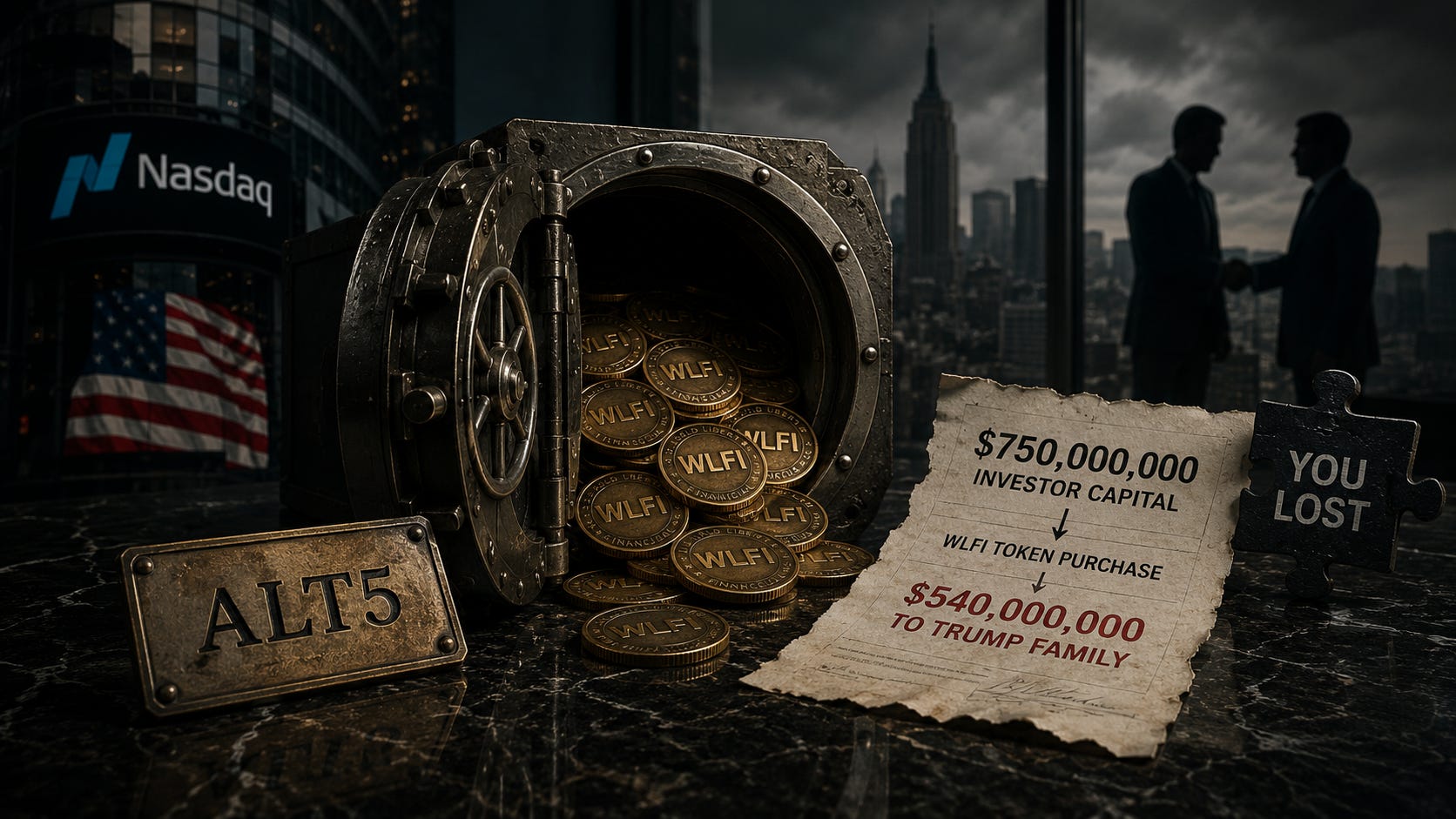
All research and reporting by WLFireside · Langdon Cage · July 31, 2026
The company that became the vault for the president’s private dollar was assembled from a failed drug company, a criminal conviction in Rwanda, two anonymous foreign middlemen, and a federal filing almost nobody read.
Bloomberg published the transaction story Thursday morning. It is accurate and important: ALT5 raised $750 million from investors, delivered more than half a billion dollars toward the Trump family, and left public shareholders with losses exceeding 90 percent. The WLFI tokens purchased at $0.20 now trade near six cents. A retail investor named Vincent Deriu told Bloomberg he lost most of $30,000 and was still holding. The Trump affiliation gave him confidence, he said.
Bloomberg found the wreckage. This explains the vehicle — and why the president’s family needed one.
The transaction did not begin when ALT5 agreed to buy World Liberty Financial’s tokens. It began earlier, inside a company that had already been bought, renamed and repackaged several times while the same people ran it. The same executive network — built around Tony Isaac — persisted through each identity. Two unnamed foreign middlemen were paid in a specially created class of stock that the filings never explained. And a criminal judgment against a subsidiary sat hidden for 97 days while $750 million in investor money was being raised.
By the time World Liberty Financial arrived, the company already had what the project needed: a stock exchange listing, outside investor money, regulatory infrastructure and a balance sheet that could absorb billions in tokens and call them assets. What it lacked was a buyer for those tokens and a reason for the public to believe the whole thing was real.
That is what World Liberty Financial provided. And then it stayed.
The Company Before the Deal
The company that would eventually become ALT5 had already been through several lives. Its most recent name was JanOne — a publicly traded company already running inside Tony Isaac’s business network. In May 2024, JanOne bought the private ALT5 Sigma operation and took its name.
Being listed on the Nasdaq mattered. A public company on a major stock exchange files quarterly reports, undergoes audits and discloses its ownership to the government. For World Liberty Financial, that meant a company whose balance sheet could hold billions of dollars in tokens and make them look like legitimate corporate assets rather than a private crypto scheme. It also meant credibility. Two sons of the president rang the opening bell. That doesn’t happen at a private company.
But first, someone had to put the deal together. Two foreign intermediaries — identified in the filings only as “finders,” with no names, no firm, no country and no explanation of what exactly they found or how they found it — received a specially created class of stock as their fee. Nobody disclosed who they were. The filing invented a new category of stock specifically to pay them. That stock was later converted into ordinary shares. The financial records from the acquisition were subsequently found to contain errors and had to be corrected.
So to summarize the paperwork: two anonymous foreign middlemen helped assemble the vessel that would eventually hold the president’s private dollar, got paid in stock that had to be invented for the occasion, and the government filing that records all of this doesn’t say who they are. That’s not a gap in the documents. That’s what the documents say.
Two of ALT5’s founders — Patrick Amyot and Jason Wong — had been formally banned by federal regulators from serving as officers or directors of any U.S. public company. Bloomberg confirmed both remained operationally important despite those bans. Wong’s continued role was not mentioned in any securities filing. What Bloomberg could not confirm was the full scope of what either of them was still doing inside the company.
The Rwanda matter arrived next.
On May 7, 2025, the Intermediate Court of Nyarugenge, Rwanda, entered a judgment finding ALT5 Sigma Canada Inc. — a subsidiary of the company — and its former principal, André Beauchesne, criminally liable for illicit enrichment and money laundering. The court ordered the dissolution of ALT5 Sigma Canada Inc. and confiscation of approximately $3.5 million in funds. ALT5 said it would appeal.
The company raised the money before investors were given that information.
The Transaction
A brokerage called Alliance Global Partners found the investors and structured the raise. ALT5 collected $750 million and used most of it to buy WLFI tokens at $0.20 each — tokens that were supposed to give holders a vote in how World Liberty Financial was run. In return, World Liberty Financial took stock in ALT5 and warrants — options to buy additional shares later at a locked-in price — giving it ownership stakes that could grow over time. Under World Liberty Financial’s own payment terms, more than half a billion dollars from the token sale flowed toward the Trump family.
The Trump sons rang the Nasdaq opening bell. Eric Trump was listed as a future board observer. Nasdaq then consulted with the company. The proposed observer role apparently never materialized. The presidential son remained central to the launch without assuming a formal role in the company that followed.
World Liberty Financial had already accomplished what it needed. Under the terms disclosed in the company’s SEC filings, it received 1 million shares of ALT5 stock, 20 million warrants and 99 million pre-funded warrants exercisable at $0.001 each. It had a buyer listed on the stock exchange. It had outside investor money coming in. It had a public company whose balance sheet could now hold billions of its own tokens — converting what had been a private crypto sale into a formal corporate asset. It had seats at the board table. And it had options to buy more of the company later, at prices it had already locked in.
Fortune, when it covered the rebrand months later, described the arrangement this way: “In August, the firm struck a deal with World Liberty Financial, a Trump family crypto company, to stockpile $1.5 billion in cryptocurrency on its balance sheet. In return, World Liberty Financial received stock in AI Financial and board seats.”
AI Financial struck a deal. World Liberty Financial received stock, warrants, board seats and governance control of the company that had just spent $750 million buying its tokens.
Somebody in that sentence is the buyer. It isn’t World Liberty Financial.
The Filing
On November 13, 2025, at 9:05 PM Eastern, a Form 3 appeared in the SEC database.
The filer: World Liberty Financial, Inc.
The company they were filing over: ALT5 Sigma Corp.
The event date on the form: August 12, 2025.
The form identified August 12 as the event date. World Liberty Financial filed it on November 13 — three months later.
The filing disclosed WLFI as a 10 percent beneficial owner — meaning the entity that actually controls the stake, regardless of whose name the paperwork is in. It disclosed Zach Witkoff as chairman. It listed shares, options to buy more shares, and 99 million pre-funded warrants — a third category of options convertible into shares for $0.001 each, a tenth of a cent, essentially free. And it used a specific phrase that does not appear anywhere in Bloomberg’s investigation, in Fortune’s rebranding coverage, or in any mainstream account of this transaction.
ALT5 Sigma Corp — Director by Deputization: World Liberty Financial, Inc.
The phrase means that World Liberty Financial — not just the individuals it sent to sit on the board, but the company itself as an institution — held formal governance status inside ALT5. It was not simply that World Liberty Financial had friends in the boardroom. It told the federal government it was part of the boardroom.
This was the first SEC filing in which World Liberty Financial formally identified its own insider and governance status inside ALT5. It was filed on a Thursday night. There was no news alert. No mainstream coverage. Almost no reaction.
Bloomberg describes the individual board appointments but does not reach the November Form 3, in which World Liberty Financial identified itself as both a 10 percent beneficial owner and Director by Deputization, effective from the transaction date.
The Dependency
After the Form 3, the structure became visible.
World Liberty Financial was simultaneously the company that printed the tokens, the 10 percent beneficial owner, the Director by Deputization, the partner that installed its own co-founders in leadership — and, after the tokens lost most of their value and AI Financial’s finances buckled, the lender.
In January 2026, World Liberty Financial lent AI Financial $15 million. The loan was structured as a Master Loan and Security Agreement and disclosed in AI Financial’s own filings as a related-party transaction.
The board formally acknowledged it was borrowing from the same entity that issued the tokens on its balance sheet, held its largest ownership stake and occupied its governance structure.
The company that had spent $750 million buying World Liberty Financial’s tokens was borrowing money from the same company whose tokens it held.
The seller had become the bank.
Tony Isaac told Bloomberg the company may seek to monetize the tokens without selling them. He did not explain how.
The company that printed the tokens needs them to be worth something. The company that bought them needs to get out without destroying the price. Neither can solve its problem without the other’s cooperation. They have not publicly explained how they plan to cooperate.
This is what $750 million in investor money bought: a locked room with two people who need each other and no key.
August 12
August 12 is not simply an unlock date.
On August 12, 2025, World Liberty Financial became legally required to disclose its ownership and transactions to the SEC — the moment formally recorded on the Form 3 that sat unfiled for three months.
On August 12, 2026 — one year later, to the day — AI Financial says its first installment of 3.32 billion tokens is expected to become freely transferable. A second block of 3.58 billion tokens faces additional conditions before it can move, including government approval of a formal resale document. Bloomberg describes the company’s broader position of approximately 6.9 billion tokens as becoming tradable on that date. The company’s own filings show that the second block cannot move until a registration statement covering the resale of those tokens becomes effective — a document that, as of this writing, has not been filed.
The date that opened the arrangement is the date that now tests whether the arrangement holds.
The Company Left Behind
The extraction story is now established. The company carrying it still needs explaining.
What World Liberty Financial entered was not a clean acquisition target. It was a company that had already cycled through multiple names and owners, with the same executive network intact at each turn. It was arranged partly by foreign middlemen who received stock and were never identified. Its financial records from a prior acquisition had to be corrected. Its founders included Patrick Amyot and Jason Wong — both formally banned by federal regulators from running public companies — who, Bloomberg confirmed, remained operationally important anyway. And its Canadian subsidiary, ALT5 Sigma Canada Inc., had been found criminally liable for money laundering by a Rwandan court 97 days before the financing closed.
World Liberty Financial did not merely find a willing buyer. It entered one that had been made available — and then it never left.
One year after the deal, the buyer and seller arrive at the same locked door.
On August 12, the architecture gets its first real test.
∼ WLFireside / Langdon Cage